Fireground.Trainingby RescueFit
15 Oct 2026Cognition v4.41: some downtown nights are a small room fire. The debrief reads what you sent to it. More → all updates
Free

Playbook

A company's plays for every incident type — who does what by riding seat, decided at the kitchen table instead of on the street.

Open to anyone — no email, no account, nothing to install.

Open the free Playbook

The department version, with live sessions on the TV and the crew's phones, is behind a sign-in. On the list? Open it →

Send feedback →

27 plays47 worked callsPlaybook v0.17
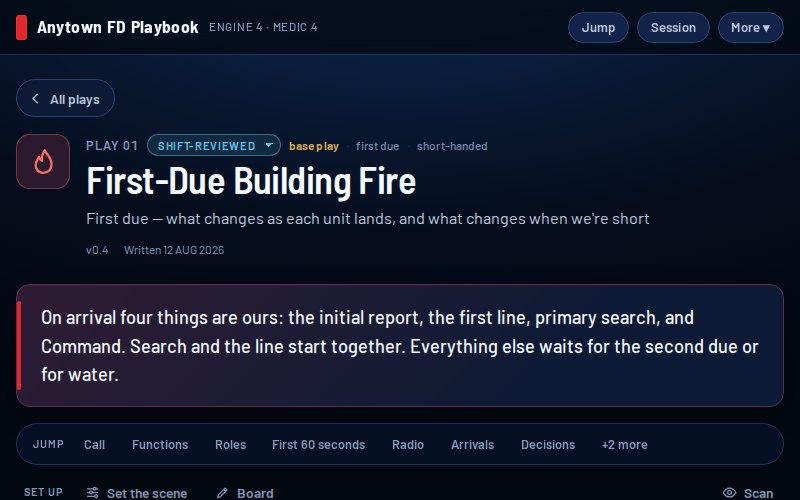
The top of a play. The sample first-due building fire: the thesis, then the jump strip and the Set up row — Set the scene, Board, Scan.
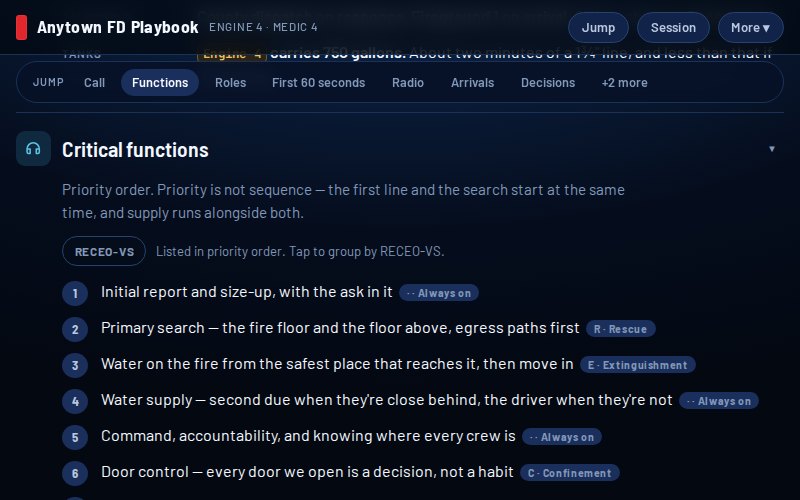
Critical functions. In priority order, each tagged with its RECEO-VS letter. The jump strip lights the section you are on.
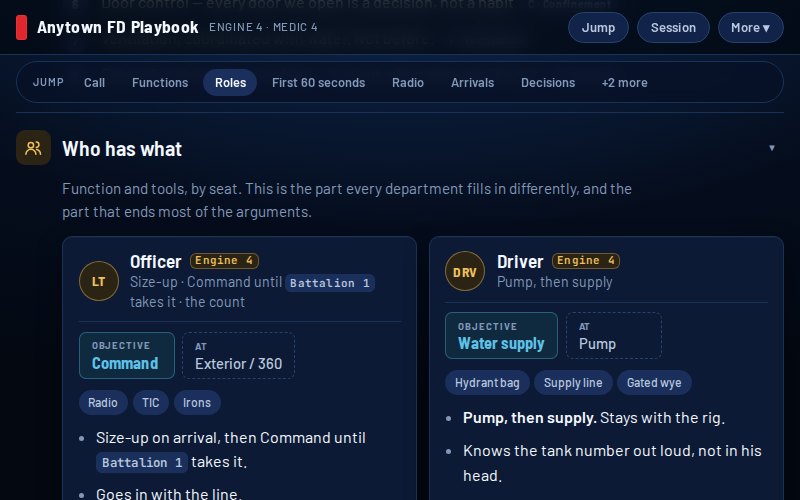
Who has what. A card per seat: the objective, where they work, the tools that come off the rig, then the tasks.
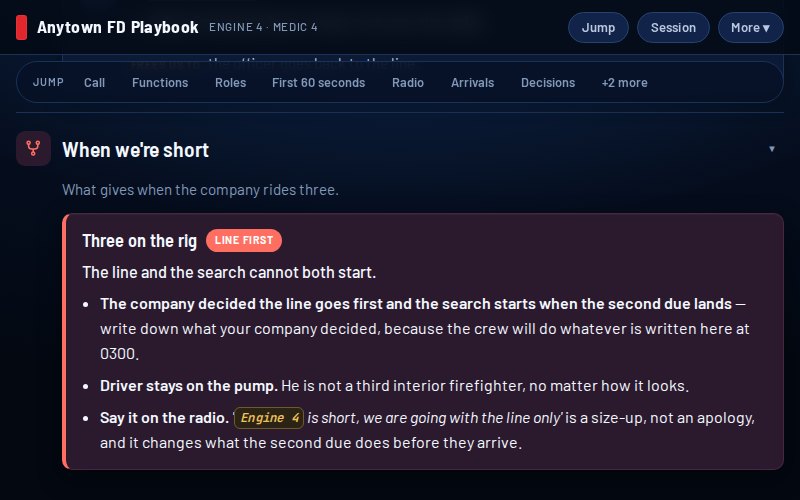
When we're short. What gives when the company rides three, and what gets said on the radio about it.
01

One spine

Every play: the call, critical functions in priority order, who has what by seat, as units arrive, radio, warning signs, and the SOPs it works from.

02

By riding seat

What the officer, the driver, the rider and the ambulance crew each own on arrival — the tools that come off the rig with them, in order.

03

For the call you're on

Chips for who's on scene and how short you are; what applies lights up. Jump takes plain words — victims second floor, no hydrant.

04

At the kitchen table

Walk the crew through a play on the TV, one section at a time — each one Agrees, Flags or Skips, out loud. A board to draw on comes with it.

The top of a play. The sample first-due building fire: the thesis, then the jump strip and the Set up row — Set the scene, Board, Scan.

A play is shown being used, not just listed

47 worked calls across the book — a dispatch, an arrival, and the call run start to finish. Each play opens on a thesis: one paragraph on what is ours on arrival.

Radio — what gets said, who says it, and when. The actual wording, urgent traffic in the department's own format.

Who has what. A card per seat: the objective, where they work, the tools that come off the rig, then the tasks.

Who has what, then the first sixty seconds

It starts with what you have alone, then what each arriving unit takes over and what that frees you to do. What gives when the company rides short is its own section.

Every play names the SOPs it works from by number, and says where the play bends one and why.

When we're short. What gives when the company rides three, and what gets said on the radio about it.

Make it your company's book

Sign in once and your name goes on every pick, flag, note and edit. Company decisions at the end of every play; flags collect into Review. Crew split on a section? Discuss hands both sides to an AI chat and the summary comes back under your name — it does not settle it, the company does.

Turn on Edit and change any line. Clone a play into a variant. Changes wait in a bar until you save; History lists every change and hands you the whole book as one file. In the free copy that file is your book.

The full list

What's in the book
  • 27 plays — eight fire, eight rescue, four EMS, four hazmat, three service.
  • Every play on the same spine: the call, critical functions in priority order, who has what by seat, what you've got, as units arrive, radio, warning signs, and the SOPs it works from.
  • 47 worked calls across the book — a dispatch, an arrival, and the call run start to finish, so a play is shown being used and not just listed.
  • Each one opens on a thesis: one paragraph on what is ours on arrival. If you read one thing in a play, that's it.
Every play, by riding seat
  • What the officer, the driver, the rider and the ambulance crew each own on arrival — the tools that come off the rig with them, and the tasks in order.
  • As units arrive, rung by rung: it starts with what you have alone, then what each arriving unit takes over and what that frees you to do.
  • Radio — what gets said, who says it, and when. The actual wording, urgent traffic in the department's own format.
  • Every play names the SOPs it works from by number, and a section on every play says where the play bends one and why.
Read it for the call you're on
  • Set the scene at the top of a play: chips for who's on scene, what you've got, and how short-handed you are. What applies lights up, the rest dims, and a Right now panel pulls it together.
  • That is per phone. It changes nothing in the book.
  • Jump takes plain words — victims second floor, no hydrant, wires on the car — and opens the section, not just the play.
  • A jump strip on every play that lights the section you are reading — a rail down the side on a laptop or the TV — and an If it becomes row: the call turned into a different call, tap it, you're in that play.
  • A board to draw on while you talk — pen, arrow, label, five colours, six base pictures from a wood frame to a blank grid. It saves with the book, so the next shift argues with your drawing.
  • RECEO-VS regroups the critical functions on fire plays — off by default, because it is a priority lens and not a sequence.
Run it at the kitchen table
  • Walk the crew through a play one section at a time, on the TV. Every member Agrees, Flags or Skips each one — the point is committing to a position out loud.
  • Present mode makes that the default: open a play and you're in the walkthrough. The board comes with it, full screen.
  • In the department version, start a session: the TV shows a four-letter code and a QR, the crew opens the book on their phones and follows along. Each phone has Agree, Flag and a raised hand; the TV's bar counts them. Hand a phone control of the walkthrough and take it back. Every session is kept as a record.
  • Show me walks a new member through the whole book live on the page in sixteen stops, and prints as a one-pager for the ones who'd rather have paper.
Make it your company's book
  • Sign in once and your name goes on every pick, flag, note and edit, so the company can see who decided what.
  • Company decisions at the end of every play — dropdowns, text fields, checkboxes — and once any are settled the index card shows how many.
  • Flag any section for review and say why: tactics question, SOP conflict, wording, needs a decision, add or remove. Review lists every flag in the book; the index filters to the flagged plays.
  • Crew split on a section? Discuss hands that piece — with the department context and the SOPs — to Claude, ChatGPT or Gemini for both sides, and the summary comes back into the book under your name. It does not settle it. The company does.
  • Turn on Edit and change any line. Add lines and take them out, put an edited one back, add or remove whole sections. Clone a play into a variant, or start a new one with every section the book expects.
  • Each play carries its own review status — Draft, Shift-reviewed, Adopted.
  • Changes wait in a bar until you save to the book. History lists every saved change with who made it and when, and hands you the whole book as one file to download or print.

The free copy is all 27 plays from a made-up department, Anytown FD. Walk them with your crew, rewrite them into your own, and download the book — that file is yours. Nothing leaves your browser unless you download it.

Open the free Playbook

The free copy: fireground.training/playbook/free. ← All the apps