Fireground.Trainingby RescueFit
16 Oct 2026Flow Path v0.71.1: open the door on a starved fire and watch it flash. Downtown rolls 180 buildings, fire in the walls. More → all updates
Gated

Cognition

Fireground decision practice. Take command or a company seat, work the call from the 911 line, key up when you need help, file the report, and read your own after-action.

Open Cognition

Sign-in takes an email that's on the list. Not on it yet? Ask for access → or email

Send feedback →

53 calls2 seats1 file, no installCognition v4.41
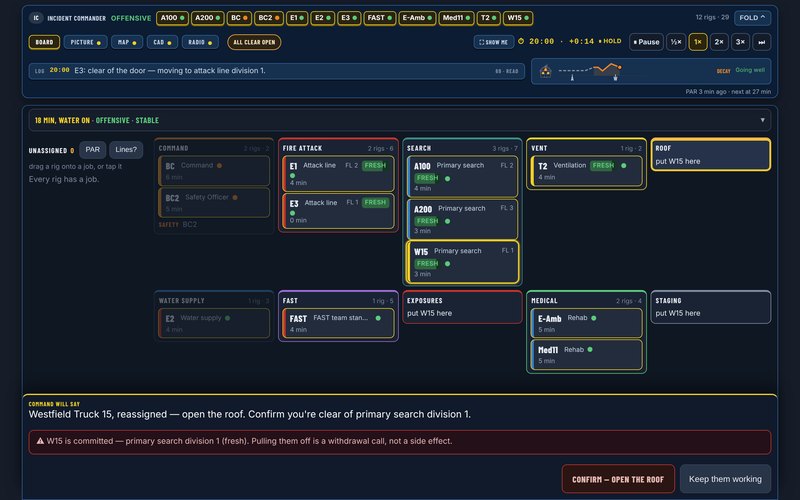
The command board. Twelve rigs, 18 minutes in, water on, every job a box, each chip with its job, its floor and its minutes. Fire Attack holds two: Engine 1 on the second floor and Engine 3 on the first. Three crews are on the primary search, one to a floor; vent, water supply, FAST, medical and the safety officer are covered, and roof, exposures and staging are open. The order in hand pulls the mutual-aid truck off the search on the first floor to open the roof, and the bar reads it back with a warning: that is a withdrawal call, not a side effect.
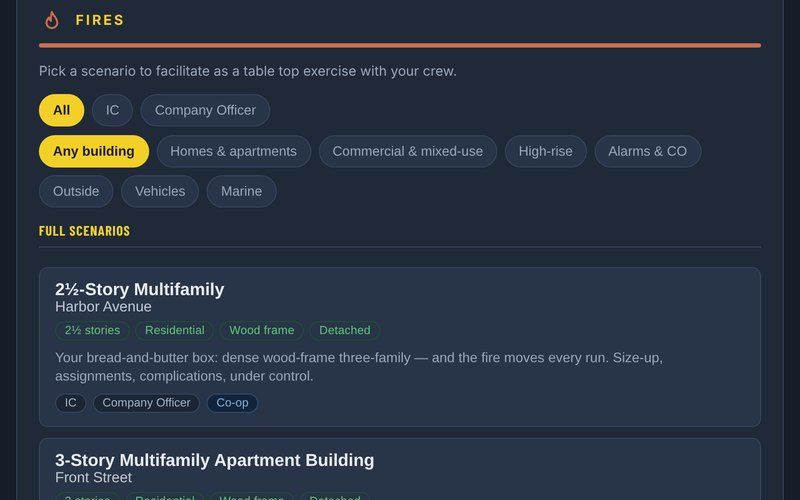
Pick the call. The Fires list, filtered by seat and by building. Every card carries its street and the building in plain words: stories, occupancy, construction, attached or detached.
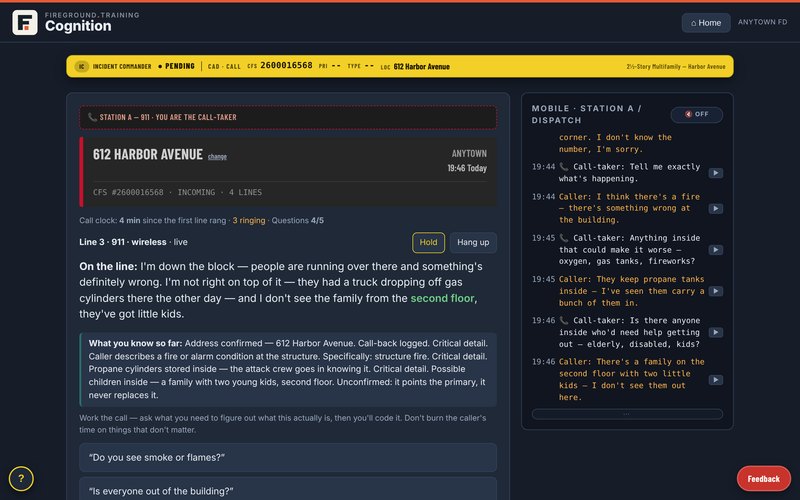
The 911 line. A caller down the block mentions a truck dropping off gas cylinders, and a second-floor family with little kids nobody has seen. Ask, and both go on the card: propane stored inside, possible children on the second floor. The call clock runs while you do.
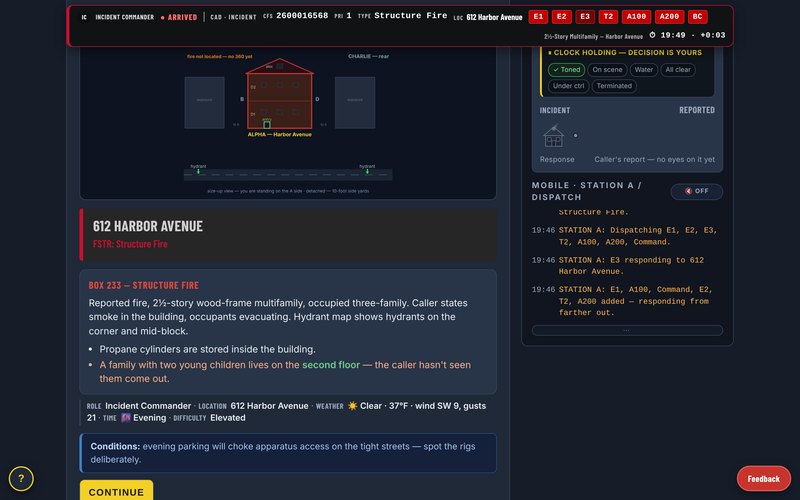
Arrival. The dispatch strip across the top, the site layout with the fire not located yet, and the box card: what the caller said, propane cylinders stored inside, and a family with two young children on the second floor nobody has seen come out. Under it tonight's roll (clear, 37°F, wind southwest 9 gusting to 21, evening, parked cars choking the street) while the clock holds for your first decision.
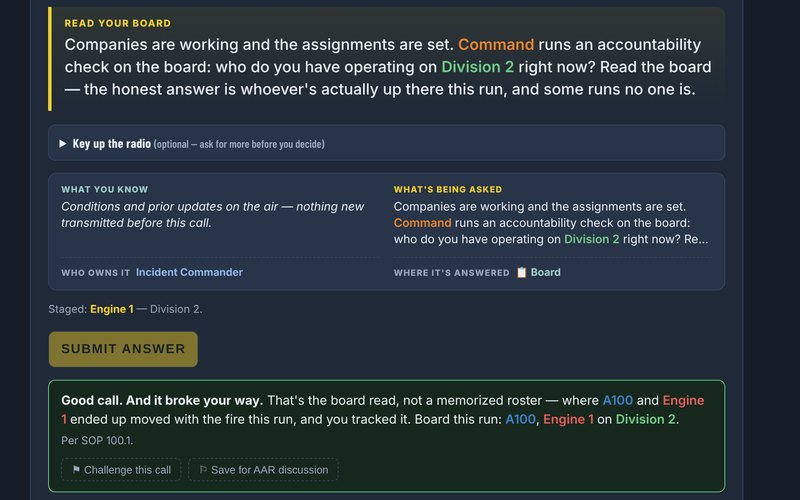
Coached. A PAR read off the board. The card says why the answer was right, names the two crews the board had on Division 2, A100 and Engine 1, and cites the SOP, with Challenge this call and Save for AAR underneath.
01

Run the call

From the 911 line to command terminates. On a building fire the traffic plays beside a street view of the building, smoke and all, drawn from what Command has been told — who is on which floor, where the line is, what the smoke is doing. Which rigs are out, the weather and the time of day roll fresh every run, so the answer can't be memorized.

02

Key up

A radio built as a control head. Strike an alarm, request resources, ask for a CAN, raise Station A. Whether the ask was right and on time sits beside the score.

03

Run the room

Presenter mode on a second screen, round-robin or two-seat co-op, a Table Top clock, and one frozen night the whole department runs.

04

Read the report

A four-tab debrief on every call, a session record per run, and a department heatmap that says what to drill next.

Arrival. The dispatch strip across the top, the site layout with the fire not located yet, and the box card: what the caller said, propane cylinders stored inside, and a family with two young children on the second floor nobody has seen come out. Under it tonight's roll (clear, 37°F, wind southwest 9 gusting to 21, evening, parked cars choking the street) while the clock holds for your first decision.

The fireground doesn't wait for the card

A problem the call had loaded cuts in ahead of your next decision — the crew's own voice tells you first. Some decisions wait until the fireground makes them real: water on the fire, a supply in, a chief on scene. A mayday can drop on any working fire, and you run it.

Orders are moments, not switches. Pull a working crew and the chip reads ORDERED; it isn't on the new job until it arrives.

Graded on the decision, not the outcome

Coached says why. Live holds it all for the debrief. When a good call only half-works, it shows the roll — what the decision was worth, what the draw came up, and whether that's a verdict on the call or just the night.

The debrief also lists what never developed, and why: the problems your decisions took off the table before they got their moment.

Pick the call. The Fires list, filtered by seat and by building. Every card carries its street and the building in plain words: stories, occupancy, construction, attached or detached.

Your department, your SOPs

Stations, apparatus, run card, EMS model, your logo, your CAD screen. Decisions cite your SOPs and open them right there. Flag one that doesn't match how you really operate, and the flags collect into a review report.

One file on a phone, and the data never leaves it. No accounts, no names, nothing posted anywhere.

The full list

Run the call
  • 53 calls — 21 fire, 10 EMS, 9 technical rescue, 5 motor vehicle, 4 firefighter emergencies, 2 hazmat, 2 marine. 19 are built out in full; the other 34 are tagged Classic — shorter, simpler calls.
  • You take it from the 911 line. Work the caller, code it, send the units. Station A asks what an extra rig or a mutual-aid pick is for. Coached grades the answer against what the call actually gave you; Live gives you what Station A put on the air and nothing else.
  • The callers know things, and not the same things every run. On the built-out structure fires the run seeds what a caller could know — the hydrant out front, the way round back, a hazard inside, who is still in there — and the caller who knows drops a hint in their opening line. Ask, and it goes on the card and reaches Command at arrival under From the 911 call. Miss it, and a crew finds it on scene, on the clock. Callers answer only what they could know, and now and then one is trapped inside and gets pre-arrival instructions from you, graded.
  • Two seats on a call — incident commander and company officer — with pass-the-device co-op so a crew runs one together. Nine calls are written from the crew's side outright: the nozzle, the ambulance, the edge of the hole. In a two-seat run a band across the top of every screen says which seat you are sitting in, in that seat's colour.
  • First due is the closest firehouse, not the dispatch order. Every station and every built-out call's pin was re-read from the Census geocoder against the address the build already carried, so the rig that gets there first is the one that would. Pick up a rig on the board and it reads its due order (1st due, 2nd due, 3rd due) and how long it has been on scene; a rig still coming shows its minutes out.
  • Rolled fresh every run: which companies are already out and when they're back, the weather, the time of day. On the built-out calls the fire's location, what's showing and who's inside are seeded too, so the answer can't be memorized.
  • Orders go out the way you'd give them on the air, and the call answers back. An order is a moment, not a switch — pull a working crew and the chip reads ORDERED while it clears the job it's on. It isn't on the new job until it arrives, and bouncing a company off air no longer hands it a fresh bottle.
  • You can run your own PAR. PAR and Lines? sit at the head of the board any time the board takes an order — you answer off your own board first, then the fireground answers on the air. Nothing about it is scored; the debrief shows how often your read matched. And the call won't put a check to you that you already ran yourself: it goes to the debrief as one you already had, with the time you ran it.
  • A live command board you work like a worksheet. Rigs with no job sit in an Unassigned tray and every job is a box: drag a rig onto a box, tap the rig and then the box, or tap the box and pick who takes it. A rig lights only the jobs it can take. Each chip carries the rig's status, its air and its minutes on the job, and the status line on top opens to the tactical priorities. It takes orders in every phase of the call: the stream, the decision cards, the complications, the closing screen. On a wide screen it stays up while the traffic plays. A job can take a second rig from the order bar. It's practice on the electronic accountability boards departments are moving to, before yours shows up.
  • A company can be split. The order bar carries a crew count: step it down and part of the company takes the job while the rest stays with the rig, each piece with its own chip on the board. Send an engine for water and you pick the lay, reverse or forward, and what the rest of the crew goes to work on. A truck riding three can take the aerial to the roof; a truck riding two isn't offered it.
  • Board first: when a card's answer is a rig, you answer it on the command board. The rigs that can answer are lit; tap one on the board, or its row under the card. Before an order goes out the bar reads back the line Command will say, and pulling a crew off a job it is committed to stops you first: that is a withdrawal call, not a side effect.
  • FAST takes its own box. When the FAST company lands it goes on the board standing by at the command post, without an order from you. Move it if you want it somewhere else.
  • On a phone the tablet takes the screen. Tap BOARD, PICTURE, MAP, CAD or RADIO and it covers the call; the button on top takes you back to the call. The radio log lives on the RADIO tab, and its newest line rides the bar.
  • The fireground talks back from the fire model. Crews call what the building is doing — smoke pushing on their floor, conditions improving, a window letting go, fire under them — and after each call the debrief says what the house did next. A right call the fire didn't reward says so; so does a poor one it let you off.
  • Losses give warning. A crew with no water in untenable conditions says it can't hold, then pulls itself back to the stair.
  • The night's weather is the call's weather. The arrival card gives the temperature and the wind, and on the 2½-story the wind lays the fire and smoke over the downwind side. Crews call it when the house next door starts taking heat: glass going, siding melting or catching.
  • One fire is run from the street, on the board. A working fire in a three-story downtown building, a business downstairs and apartments above, played on the map of the block. The building is rolled: a real downtown building that has been checked, with one generated to fit it, so its width, its floors and whether a store, a restaurant or a bar is on the ground floor change from run to run, along with the hour, the fire, the wind and who is inside. The fire can start in the business downstairs. Nothing asks you on a card but somebody at the command post, a big change in the building or a mayday: a rig that lands rings amber on the board with what it wants, a crew in trouble rings red, and you answer on the board while the clock runs. On some nights a caller sees somebody at an upstairs window, and the board keeps VICTIM SHOWING up until a ladder gets there.
  • About one night in six the downtown fire is a small one: a room fire behind a shut door that the first line can hold. It goes out early, and the debrief reads what you brought for it: alarms struck, companies called past the first alarm, rigs standing with no job, a defensive call, crews pulled. Every debrief says where the fire went: rooms, wall bays, the cockloft.
  • A secondary search is offered only once the fire is knocked down, on every call.
  • On a building fire the radio log runs beside a picture of the building as it looks from the street — siding, roof, windows, and the smoke Flow Path's fire model pushes out of them — and five buttons walk you round it: Front · A, B, Rear · C, D and Overhead. It shows what Command has been told, not what is true. The house stays solid until a crew goes in, and only their floor opens. The B, C and D sides stay blank until somebody walks the 360. A crew sits where it last said it was or where you sent it, and one you haven't heard from in six minutes starts to fade. Smoke climbs a floor at a time, and a roof opened before the line is in makes the fire floor run hotter. The unit talking keys up on the drawing. Seven buildings are drawn room by room; the rest get a simpler block built from the call. Nothing in the picture is scored. Calls that aren't a building fire run the same stream screen they always did.
  • Every kind of rig knows what it is for. A truck company can stretch a line and an engine can get to a roof — the option is offered, the work takes half again as long, and a line under it says why. None of it is scored; it costs minutes on the fireground clock. The hard refusals stay hard: a truck does not lay a supply, and the intercept paramedic and the mutual-aid ambulances get no fireground job at all, the primary search included. Your own ambulance is a crew of firefighters and is offered a line, the roof, utilities, a search or RIT at that same cost.
  • Put a second crew on the same job and it comes off what the first crew has left, once, and they say so on the air — attack, roof and vent. A search is never helped: the second crew goes to a different floor on purpose.
  • The fireground doesn't wait for the card. A problem the call had loaded and ready cuts in ahead of the next decision rather than sitting behind it — the crew's own voice tells you first — and then the call hands you back the decision you were on.
  • And some cards wait for the fireground. A decision can say what has to be true before it gets asked — water on the fire, a supply in, a chief on scene, a particular rig on the ground — and the call holds it until it is, then asks it the minute it is. If it never comes true it goes in the debrief as never came up, and why, instead of being asked into a call that never got there.
  • Where's this going? Once a call, and never in the opening cards, the game stops between cards and asks what the fireground does next: the fire extends, a crew goes low on air, a water problem, a victim found, or no change. Same five options every time, so the list tells you nothing. The debrief says what you saw coming and what you missed. Not scored. Off in Table Top unless you turn it on.
  • A mayday can drop on any working fire without warning, and you run it: take the channel, get the information out of the member, commit the rescue, place the package, PAR, all clear. Nothing about it is narrated. Some drills are nothing but the mayday.
  • It ends the way a call ends — the turn, the transmission, winding down, command terminates. Then the Fire Report, which is a records screen: CAD fills the address, the dispatch code and the incident type and you verify each one, the property use is a two-level pick, and the narrative drafts itself under two prompts and archives word for word. Filing is optional. Skip it and the training row reads NO REPORT.
Key up
  • A radio tab, built as a control head rather than a row of buttons: the department's own zone and channel on the display, and a transmission is a press and a release — hold it and the LED goes red, let go and it unkeys. Drag off before you release and nothing goes out. That head is the portable on the fireground channel; the column beside it is the mobile to Station A, and each one says which it is. At any point on any of the 53 calls the IC can strike an alarm, request resources, ask a company for a CAN report, raise Station A, or order a withdrawal.
  • Nothing gets invented. The alarm rolls real rigs off your run card with real ETAs. The specials on offer are the ones that call's own decisions authored — a call that authored none gets the two that are legitimate anywhere, and the pane says so. Station A answers only from what the desk actually holds, and says plainly when it holds nothing.
  • Strike the second alarm and the callback goes out with it. The reserve engine and truck staff up as members come in, show on the board inbound, and land a few minutes apart.
  • Mutual aid is one list, the department's own: every agency, what it has, how far out. Ask for an engine, a truck, an ambulance, a medic or a rescue from the dispatch screen, on the way in or off the radio, and Station A works down it closest first. Some nights a town has nothing free and the rig comes from farther out. Pull a lot the call doesn't need and the Deputy asks what it's all for. The roster is editable in Settings.
  • Key up as often as you want. What gets read is whether the ask was right and whether it was timely — it sits beside the score as radio discipline.
  • The withdrawal wears the red the app reserves for a call you can't take back, and it tells you how many working companies you're about to pull before you transmit.
Run the training night
  • Presenter mode puts the exercise on a second screen — the room sees the scene, the radio and the discussion clock while you drive it from your own device. Cable, cast, AirPlay or screen share; the steps for Windows, Mac, Chromebook and tablets are on the setup screen.
  • Three ways to run the room: instructor-led, round-robin turns, or two-seat co-op. Table Top mode poses the decision, gives the room a clock on it, then reveals the talking points.
  • Telling the calls apart. Every call card carries the rest of its title, usually the street, and the building in plain words — stories, occupancy, construction, attached or detached — read from the call's own building data. Fires filters by building (homes and apartments, commercial and mixed-use, high-rise, alarms and CO, outside, vehicles, marine) and by the seats the category actually has, and every category has its own icon.
  • The Weekly: one frozen night the whole department runs off a shared code. Same call, same conditions, everybody compared.
  • A voice cast reads the traffic aloud — the dispatcher, the 911 callers, three company officers and a narrator, with the station-alerting readout kept to its own voice so the machine still sounds like the machine. Voices come off the device, so audition and assign them in Settings first. Off by default, and one button on screen cycles the radio audio off / sound / voices without leaving the incident.
  • Start Here walks a first-time user through three calls on the real screens — an offer, never a gate.
  • On a placement question in guide mode the screen names what the rig is there to do, which cues on the map are live right now, and the three questions that decide every position. It does not draw an arrow — the right spot moves with the fire side, so an arrow would be wrong as often as it was right.
Reports
  • Three settings for when the game explains itself. Coached grades every call and says why. Live runs the call and holds all of it for the debrief. Auto coaches the first time and goes live after. On the live path a commit reads as a delta instead of a verdict — which unit moved, what came over the air, what is still open, and whether any of it needs Command.
  • When a good call only half-works, Coached says so, and shows the roll: what the decision was worth, what the draw came up, and whether that is a verdict on the call or just the night. Once per device, the first time each thing happens.
  • After a call that wasn't the best one, the card names the option that was, in the words that option carries. On a Live run it is held for the debrief, and the grade, the score and the outcome are untouched either way.
  • A debrief on every call in four tabs: the night and how the incident actually ran, every decision with the evidence behind each call-out, the reports you filed, and the discussion points.
  • The debrief also lists what never developed, and why — problems the call had ready that a decision of yours took off the table before they got their moment, with the radio line that settled each one. Nothing there is scored. It is the only place a call that prevented something shows up as anything at all.
  • The Reports tab has a replay. Drag a bar across the whole call: on the left, the building as you had it at that minute, built only from what had come over the radio; on the right, what it was really doing. Orange marks sit on the minutes you made a call while the two didn't match. It only reads. Nothing in it is scored.
  • One session record per completed run, in any mode. It holds activity only — no grade, band or score can be written into it by construction — and it feeds the training officer's export: entry sheets in ESO's Add Class order, a CSV one row per attendee, and a coverage view of who has gone stale. The row also says whether the report got filed.
  • Department Report: a competency heatmap sorted by your priorities, a knowledge-vs-judgment read on each row, the calls your people split on, honest not-yet-tested gaps, and what to drill next. It says small sample when it is one instead of pretending.
  • Evaluator's Tour for a chief or training officer — what gets measured, how, and the report it feeds. Includes a one-pager to hand over.
Your SOPs, and whether they're actually working
  • Decisions cite your SOPs. When one is in play it opens right there — read it, argue about it, keep going.
  • Flag an SOP when it doesn't match how you really operate, or when you disagree with it.
  • Flags collect into a review report: which SOPs your people don't follow, and whether the answer is a rewrite or a drill.
A document library that's open while you train
  • Your SOPs, state protocols, NIOSH reports, the ERG, pre-plans, your run card — link to a shared drive or attach the file.
  • Members open them from inside a scenario, while the question is still live.
Capture the discussion
  • One tap saves any decision for the AAR. The run keeps moving; the flags come back at the review as discussion points.
  • Copy the whole package — every option, the grading, the conditions in play, the SOPs — into any AI chat you use. Claude, ChatGPT and Gemini are one tap off the screen. It's framed to argue it out with you, not to hand you an answer.
  • There's a packet for the whole night, and one for the room's night — the same copy and paste, across every call you ran.
  • Disagree with the decision the game preferred? Challenge it, with the full decision attached. Nothing to retype.
  • Every screen names itself in small type under the bar — the call, the card on screen, the phase, your seat. The Feedback button files against that stamp with a category, the last twenty radio lines and the roll already attached, and sends in one tap. Nothing to write down, nothing to remember later.
Make it your department
  • Stations and apparatus, run card, EMS model, your logo on the header. The CAD screen is skinned to your real call-detail display, colours and all.
  • Rate what each of the eight command competencies is worth to your department, 1 to 5, behind a PIN. That's what sorts the report and the drill recommendations — it never touches in-game scoring.
  • Every scenario is tagged — building stock, hazards, SOPs, competency — so the library can be curated to look like your district.
  • One file on a phone, and the data never leaves it: members export a small anonymous file, you import it, the report aggregates. No accounts, no names, nothing posted anywhere. It reaches the internet for three things and none of them carry your data — the street map tiles on the MAP tab, the map library, and one font. With no signal the MAP tab falls back to the location in words and the rest of the call runs normally.
  • Or describe a call the way you'd describe it at the kitchen table on the Submit a Scenario form. It gets built and sent back to you.
What’s coming In development
  • Crew characteristics. The shift roster already holds a training officer's read on six attributes per member. The next builds put those attributes into the seats — so you can see how a crew's mix changes the outcome, and balance crews on purpose instead of by seniority.
  • Drill certificates, and a certification challenge once a member has earned enough of them.
  • More scenarios, and more of yours.

Evaluation build, updated often. It runs on one real department's calls and radio traffic, so it sits behind an email gate — ask and you're on the list.

Open Cognition

The app itself: fireground.training/cognitive/app. ← All the apps